
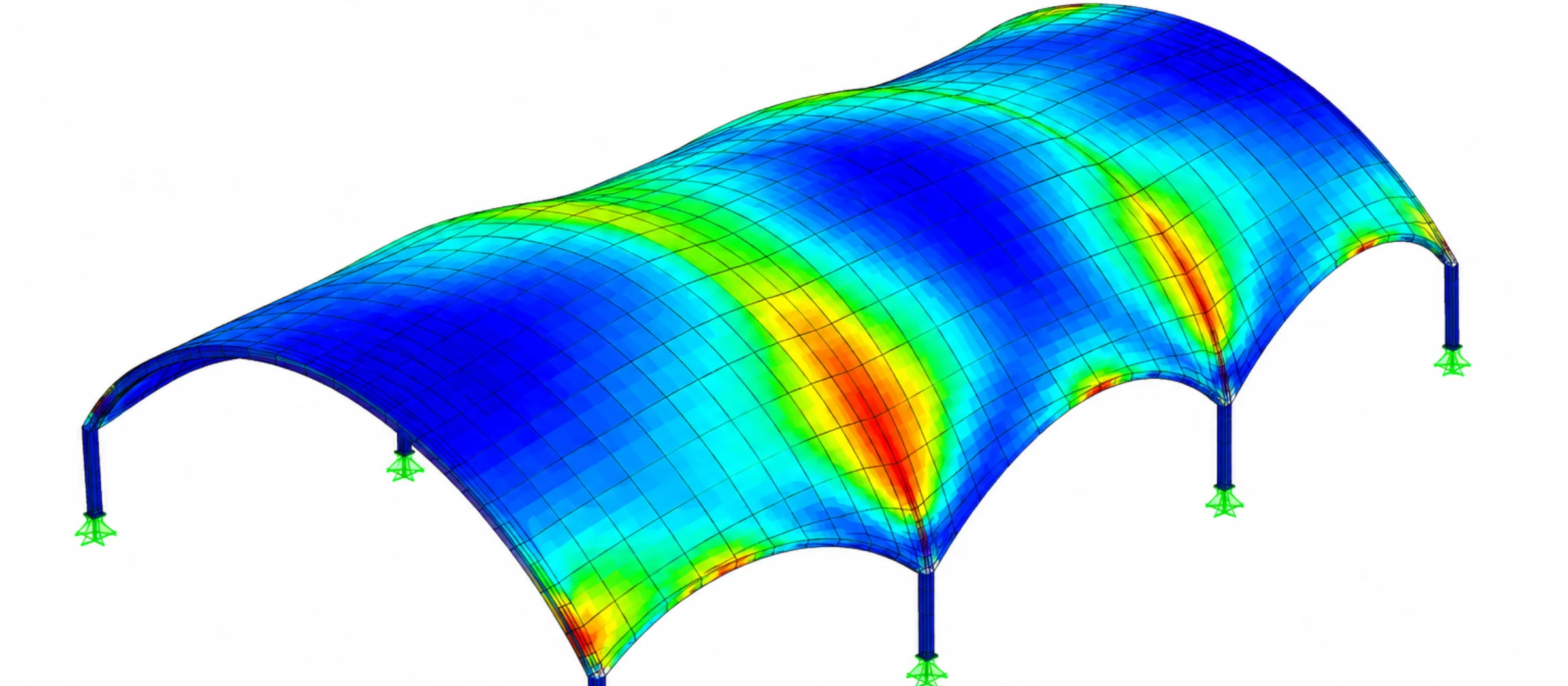
Our most important program: it was born during Dr. Mario Galindo's doctorate at the UPC in Barcelona and remains in permanent development.
FemLab (Finite Elements Method Laboratory) is the most important program at Galindo Ingeniería. It was initially developed at the Polytechnic University of Catalonia, during Dr. Mario Galindo Queralt's doctorate, and remains in permanent development to this day.
FemLab performs nonlinear analysis, both geometric and mechanical, by the finite element method, considering static, dynamic and thermal loads. Its most distinctive capability is accounting for the interaction between several solids and fluids simultaneously, with parallel processing to solve large models.
Its development began in Fortran and, since 1992, it was rebuilt in C++ and linked to a pre- and post-processing program to prepare the geometry and visualize the results. With FemLab we have solved everything from the seismic verification of entire towers to impact simulations and the study of the galloping effect on high-voltage lines.
The numerical method behind FemLab
It is a numerical method that divides a structure into thousands or millions of small pieces (elements) joined by nodes. By solving the equilibrium equations at each node, you obtain how the whole structure deforms and what stresses appear in it, even in geometries that have no analytical solution.
Linear analysis assumes the structure responds proportionally to the load and recovers its shape when it is removed. Nonlinear analysis considers large displacements (geometric nonlinearity) and materials that yield or crack (mechanical nonlinearity): it is essential to predict the real behavior under extreme loads. FemLab solves both.
Many real problems couple solids and fluids: the water inside a tank, the wind on a cable or the thrust of a liquid against a wall. FemLab models several solids and fluids at once, so that the movement of one influences that of the other within the same simulation.
An in-house program makes it possible to solve problems that commercial software does not address and to adapt the method to each project. FemLab was born during Dr. Mario Galindo's doctorate at the UPC in Barcelona and has been continuously improved ever since.
We design, calculate and verify structures in Bolivia and abroad, in person or remotely.
Let's talk about your project