
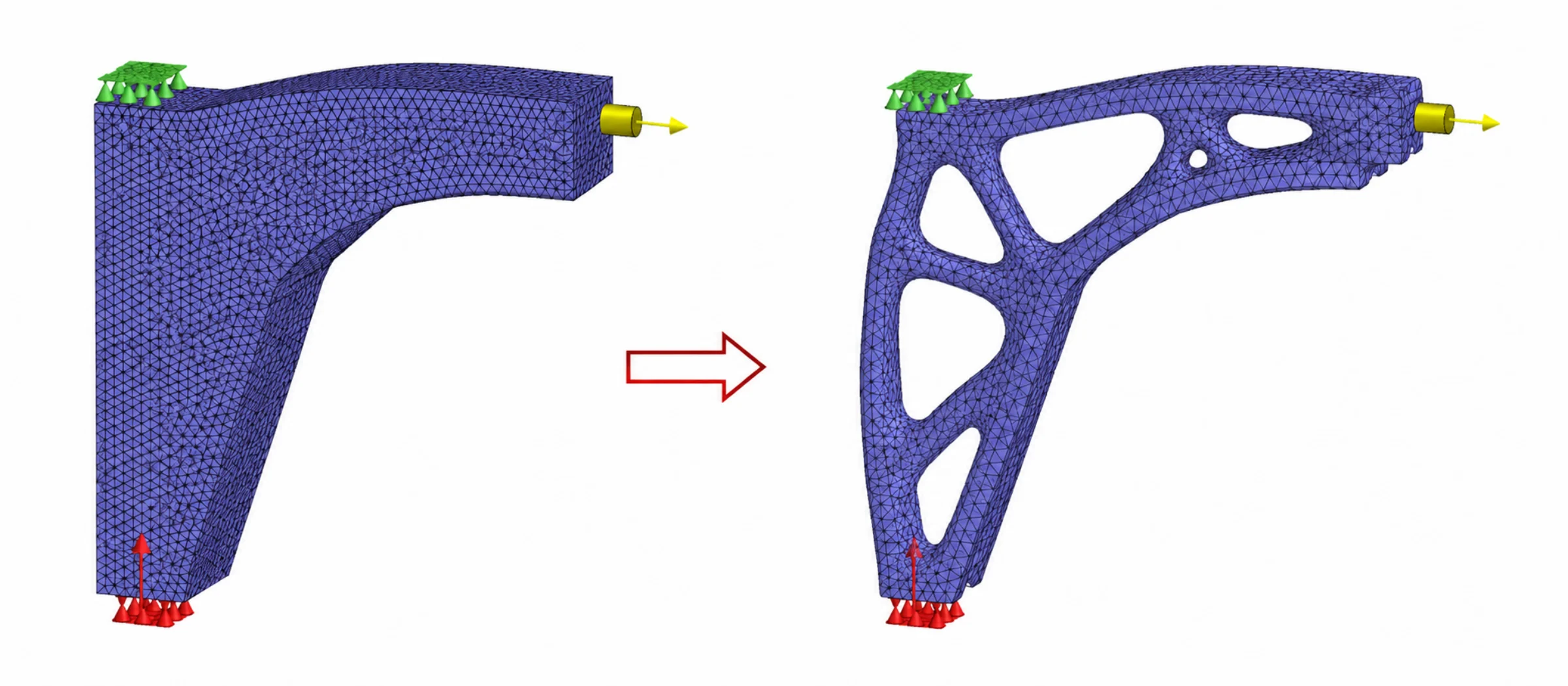
No visual interface, but with algorithms that have meant significant savings for our clients: pure optimization, coupled to our analysis programs.
GALGO (Galindo General Optimization) is a general structural optimization program that interacts with our other structural analysis programs. It incorporates different search algorithms for the optimal solution, which allows us to offer significant savings to our clients. It is developed in object Pascal.
Although GALGO does not have a visual interface, it is implemented through modules that interact with commercial software. For example, the Abaqus program has optimization modules: we made GALGO able to interact with it, extending its reach to problems that commercial software cannot solve on its own.
Optimization seeks the most efficient solution that meets all the code's safety requirements. Instead of proposing a structure and verifying it, GALGO automatically explores the solution space until it finds the most convenient one, and that saving is passed on to the client's construction cost.
What GALGO does and why it saves costs
It is the process of finding the best possible solution (the most economical, lightest or stiffest) that meets all the code's safety requirements. Instead of proposing a solution and verifying it, the algorithm automatically explores thousands of combinations of dimensions and materials until it finds the optimal one.
It depends on the project, but a well-planned optimization significantly reduces the use of materials such as concrete and steel, without compromising safety. That saving is passed directly on to the client's construction cost.
No. The algorithm always works within the code's constraints: every candidate solution must meet the strength and service limit states. Cost is optimized, never safety.
GALGO interacts with our own analysis programs and also with commercial software. For example, we coupled it to the optimization modules of Abaqus to solve joint problems.
We design, calculate and verify structures in Bolivia and abroad, in person or remotely.
Let's talk about your project