
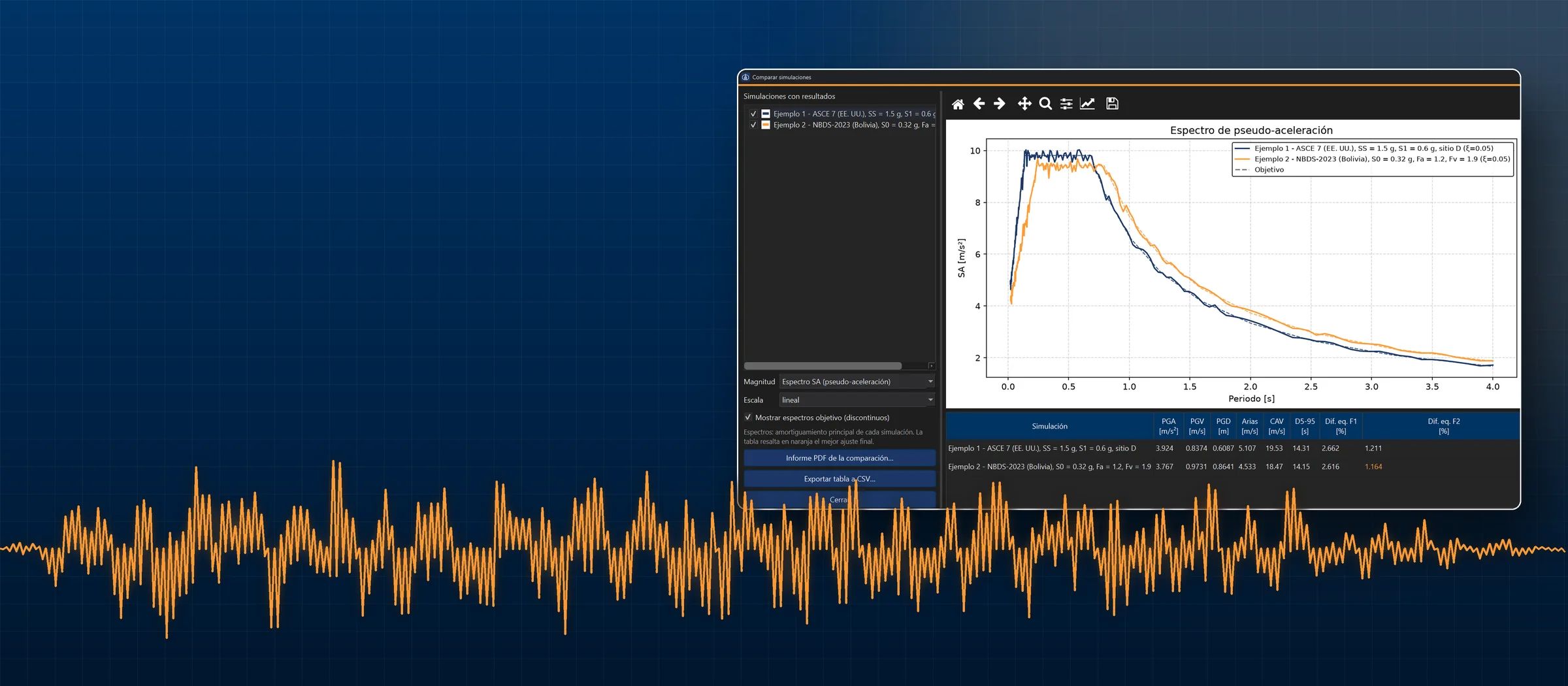
From the code spectrum to an earthquake in time: accelerograms that follow the target spectrum with typical differences of just 1%.
Earthquake 2025 is the desktop application for earthquake_2025, the program by Dr. Mario Galindo Queralt to generate artificial earthquakes. It creates accelerograms with superior spectral compatibility for structural time-history analysis, linear and nonlinear, even for structures with seismic isolation or energy dissipation.
Seismic codes define the action through a response spectrum, but time-history analysis needs an acceleration record. The program bridges both worlds, and it is distributed free of charge under the MIT license, together with its monograph.
The method was born in the author's doctoral work at the Polytechnic University of Catalonia (1993), on the seismic analysis of concrete dams. In 1994 he wrote the chapter on spectrum-compatible artificial accelerograms in the CIMNE monograph Definición de la acción sísmica. The program has versions from 1992, 2005, 2022 and 2025, and its solver is deliberately kept in Fortran 77 for compatibility with the finite element community.
The result follows the target spectrum with typical differences of just 1%, for one or several damping ratios at once, along with its intensity parameters: PGA, PGV, PGD, Arias intensity, CAV, Housner intensity, D5-95 significant duration and Husid plot.
The application reproduces the results published in the monograph exactly: the chapter 5 examples and the appendix C case study give the same values, digit by digit. Every example is checked the same way before each release.
It is the same method we used for the verification of the El Dorial Building, where the tower model was subjected to 16 artificial earthquakes compatible with the design spectrum provided by the Embassy of Canada.

Installer for Windows 10 and 11, monograph in English and Spanish and a video guide, on the Downloads page.
What Earthquake 2025 solves
It is a ground acceleration history generated by calculation instead of recorded during a real earthquake. It is built so that its response spectrum matches the code design spectrum, so it represents the seismic action required for the site.
It follows the response of the structure instant by instant during the earthquake. It is essential for nonlinear analysis and for structures with seismic isolation or dampers, where the spectral method is not enough; ASCE 7, for example, requires nonlinear time-history analysis for isolated structures.
ASCE 7 (USA), Eurocode 8, NBCC (Canada), BSL (Japan), NCh433/DS61 (Chile), CFE-MDOC (Mexico), NTE E.030 (Peru) and NBDS-2023 (Bolivia). Any spectrum can also be entered point by point.
Yes. The program and its monograph are distributed free of charge under the MIT license. They can be downloaded without sign-up from the Downloads page.
Windows 10 and 11, 64-bit, with no administrator rights needed. There is an installer and a portable version. A Linux version is in preparation.
We design, calculate and verify structures in Bolivia and abroad, in person or remotely.
Let's talk about your project