
To determine the maximum earthquake, we verified the seismic capacity of the entire building: 28 floors and more than one million finite element nodes.
The Embassy of Canada in Bolivia, located on the 14th floor of the El Dorial tower (28 floors, 109 m tall), in La Paz, commissioned us to carry out the seismic verification of the thermomechanical installations of its offices. The scope included cable trays, HVAC ducts, cooling equipment and, in general, the set of installations arranged within the false ceiling. The office in charge of receiving and reviewing correspondence was also verified. The entire project was developed under strict compliance with international standards, specifically ASCE 7-22 and the Canadian standard CSA S304-14.
The thermomechanical installations, being attached to the ceiling slab of the 14th floor, experience a seismic demand very different from the one recorded at ground level. This happens because the building's structure transforms and amplifies the seismic waves that reach its base. For this reason it is essential to model the entire tower, in order to know precisely the real dynamic behavior at the level occupied by the embassy.
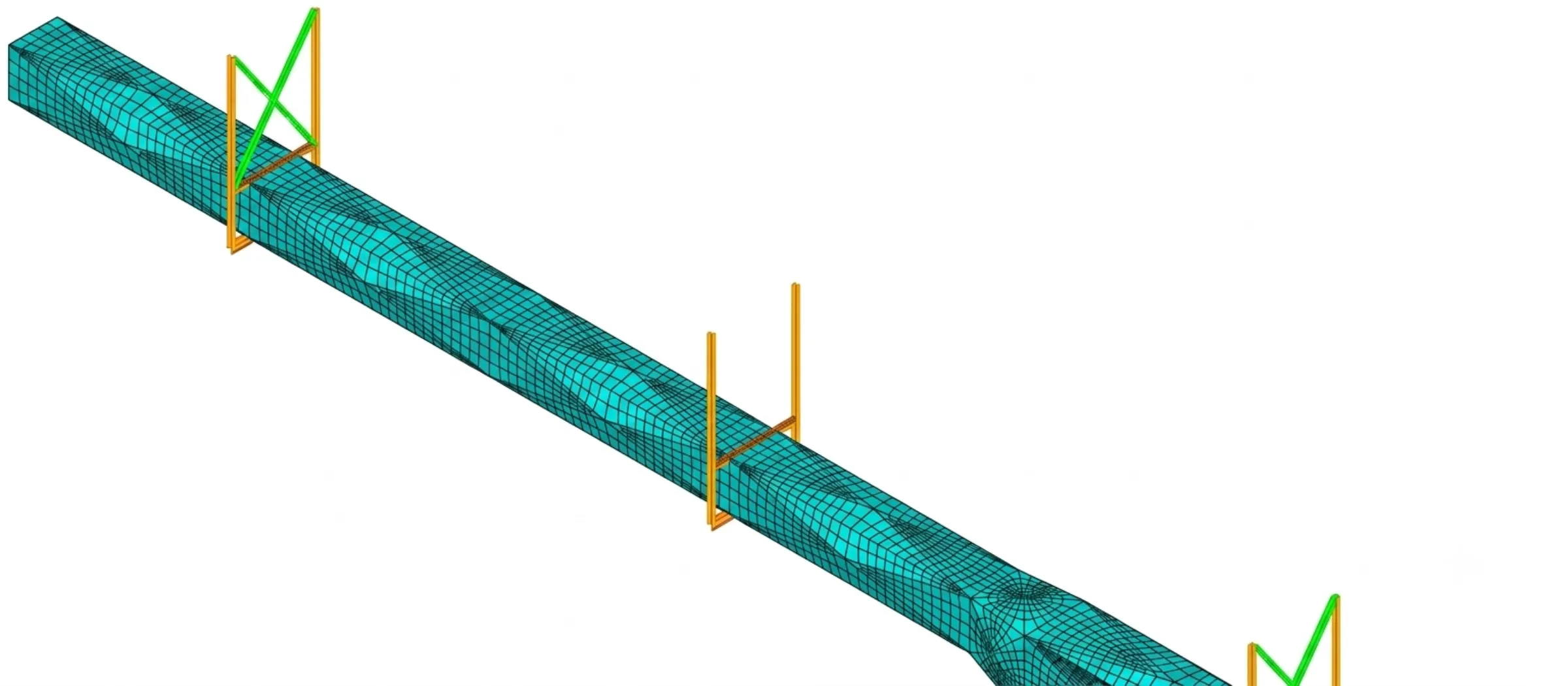
To determine the maximum seismic demand on the installations, the building's global behavior was modeled: a finite element model of the entire tower was built, integrating 1,031,102 nodes and 147,595 elements. That virtual structure was subjected to a set of 16 artificial earthquakes compatible with the design spectrum provided by the embassy, which made it possible to extract the precise seismic response at the ceiling slab of the 14th floor. From those movements, detailed three-dimensional models of each installation were evaluated through time-history analysis to determine their seismic capacity. Under a performance-based design approach, these models made it possible to detect deficient zones and anticipate the failure mechanisms under extreme seismic events: with those findings, localized reinforcements were recommended for certain anchors and the installation construction methods were validated. Finally, the effectiveness of the reinforcement was verified with an on-site load test of 150 kgf on an anchor, which confirmed the full safety of the system. Thus, Galindo Ingeniería ensured international regulatory compliance, the operational continuity of the diplomatic mission and maximum safety for the personnel against extreme earthquakes.
We design, calculate and verify structures in Bolivia and abroad, in person or remotely.
Let's talk about your project